

Digital Humanism – 2nd International Interdisciplinary Research Conference
Call for Papers! Submission Deadline for extended Abstracts: August 15, 2026.
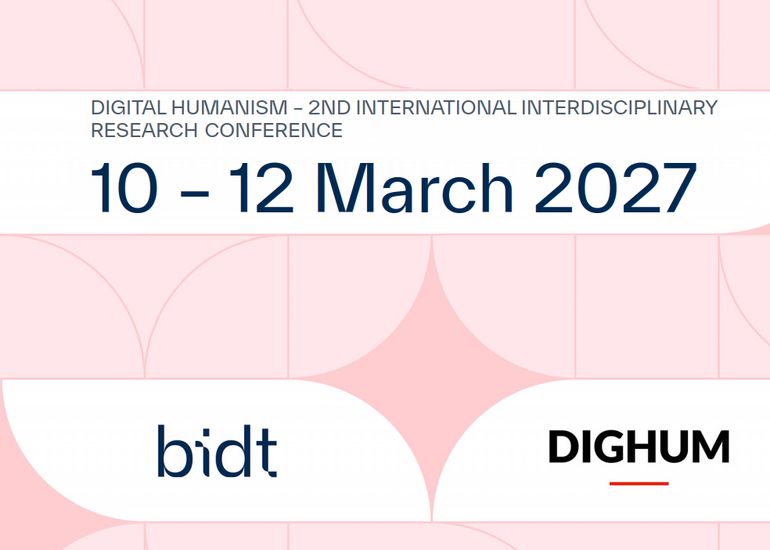
March 10th – 12th 2027
- All day event.
- Bavarian Academy of Sciences Humanities (BAdW)
- Alfons-Goppel-Straße 11, 80539 Munich, Germany
On This Page
About the Conference
Digital technologies are transforming our world at an unprecedented pace, shaping societies, economies, and cultures. Digital Humanism is constituted by a specific view on these technologies and their implications. It rejects widespread interpretations of software systems as genuine agents, endowed with mental states, intentionality, insight and empathy. Only humans are responsible for what they do and believe, not digital machines. Successful simulation of human behavior in generative AI, artificial general intelligence or humanoid robots must not be confused with the realization of personhood.
Digital Humanism is about using digital technologies as means for a better future: better workplaces, better education, higher productivity, less consumption of natural resources, less poverty etc. It strives to strengthen the human capacity to shape the conditions of a humane life on earth.
Addressing the challenges of the digital age requires collaboration across disciplines. The conference invites contributions from a broad spectrum of disciplines ranging from computer science, social sciences, economics, the humanities to philosophy. Topics include AI ethics, governance and regulation, privacy and digital rights, participatory approaches, the economics of digitization, human-centered AI, environmental impacts, the design and evaluation of AI and other software systems for the social good, and novel technologies for meaningful human-AI collaboration.
We welcome a wide range of research methodologies, from technical and empirical studies to philosophical reflections and theoretical considerations fostering a shared humanistic understanding that bridges technical, societal, political, and cultural perspectives.
Join us in Munich to engage in this crucial conversation and help shape the future of digital technologies based on humanistic values and norms for the benefit of all.
The Bavarian Research Institute for Digital Transformation (bidt) is pleased to welcome you as the host of the “Digital Humanism – 2nd International Interdisciplinary Research Conference” taking place in Munich, Germany, from March 10 to March 12, 2027.
Call for Papers
We welcome contributions from all disciplines.
Digitization is one of the most transformative technological developments in human history, comparable to the impact of agriculture, industrialization, and electrification. It is reshaping cultural, economic, and social life in profound ways. Early optimism surrounding the digital age — including hopes for greater freedom, participation, and global democracy through the World Wide Web — has increasingly been accompanied by concerns about the erosion of democratic institutions, the decline of public discourse, social fragmentation, and the growing influence of artificial intelligence. Between utopian enthusiasm and apocalyptic fears, Digital Humanism offers a third perspective: technological progress is neither autonomous nor inevitable, but fundamentally shaped by human decisions and responsibilities.
Digital Humanism rests on two central critiques. First, it rejects “digital animism,” the tendency to attribute personhood, intentionality, or moral capacities to digital systems. While AI systems may convincingly simulate reasoning, emotions, or empathy, simulation must not be confused with genuine consciousness or moral agency. Second, it opposes “digital mechanism,” the reduction of human beings to computational systems. Humans are not machines; they are embodied, vulnerable, empathetic, and capable of cooperation, moral reflection, and self-transcendence in ways that cannot be reduced to software processes. Rather than interpreting humans as machines or machines as persons, Digital Humanism emphasizes the distinctiveness of human beings and advocates the responsible use of digital technologies to expand human capabilities and social well-being. A humane technological development should strengthen human agency, democratic participation, and social inclusion, while contributing to economic progress, ecological sustainability, and the preservation of human dignity.
Deadline and Notification
Submission Deadline for extended Abstracts: August 15, 2026.
Notification of acceptance will be issued by End of October 2026.
Short and full papers are due by March 26, 2027.
Publication and post-conference summary:
Accepted contributions will be published as an Open Access volume in Springer’s Lecture Notes in Computer Science (LNCS) series, scheduled for publication in July 2027. All submissions must follow the Springer LNCS guidelines
Details
For the most up-to-date information about the conference, submission guidelines, and further readings, please see the official conference website from The Bavarian Research Institute of Digital Transformation (bidt).