

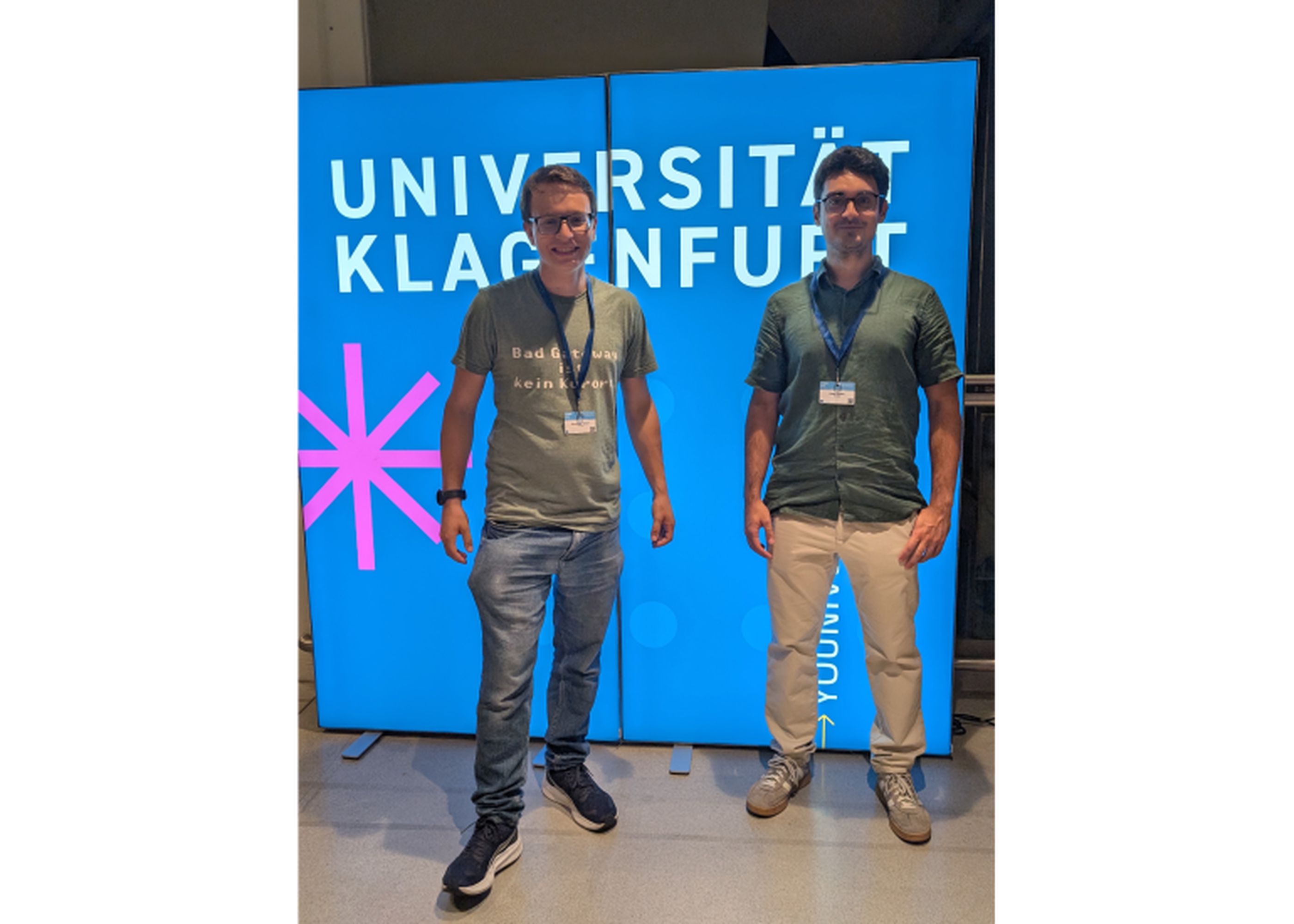
Kaan Unalan and Alexander Beiser present at LPNMR 2026 in Klagenfurt
CAIML doctoral researchers Kaan Unalan and Alexander Beiser presented two papers at LPNMR 2026, the 18th International Conference on Logic Programming and Non-monotonic Reasoning, in Klagenfurt, Austria.

From 7 to 11 September 2026, the 18th International Conference on Logic Programming and Non-monotonic Reasoning (LPNMR 2026) took place at the University of Klagenfurt. CAIML was represented by two doctoral researchers presenting papers published in the conference proceedings (Springer LNAI).
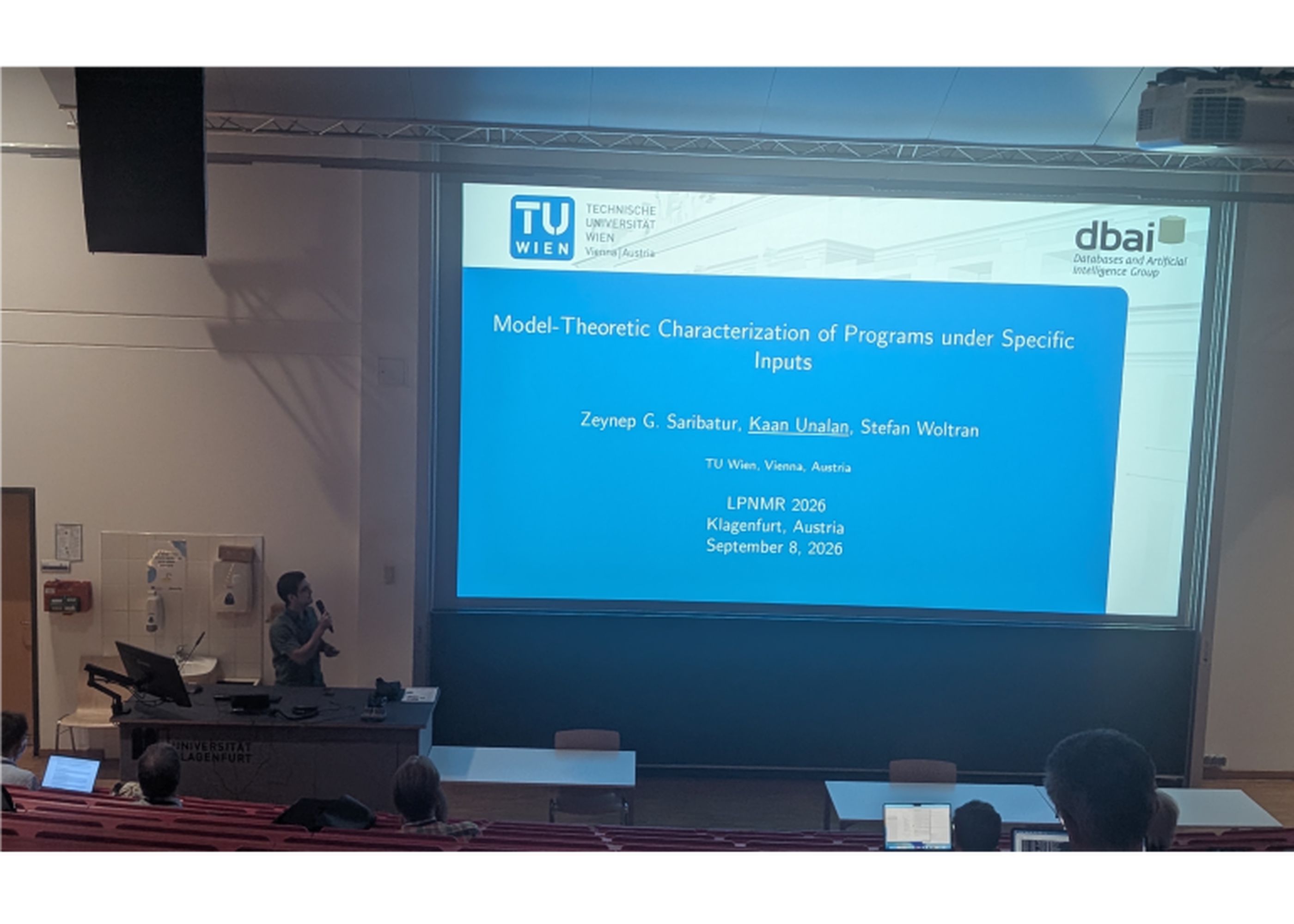
On 8 September, one year into his PhD, Kaan Unalan presented Model-Theoretic Characterization of Programs under Specific Inputs, joint work with Zeynep G. Saribatur and Stefan Woltran. Uniform equivalence is an established tool for checking whether two answer set programs behave identically under any set of input facts. In practice, however, developers often only care about specific problem instances. The paper therefore generalizes uniform equivalence to χ-equivalence, where χ describes the admissible inputs. It introduces χ-models, a new model-theoretic characterization of how programs behave on exactly this restricted input set. Two programs are χ-equivalent precisely when their χ-models coincide. Because there can be far fewer χ-models than answer sets across all admissible inputs, they offer compact access to a program’s semantics. A first complexity analysis of deciding χ-equivalence rounds off the paper.
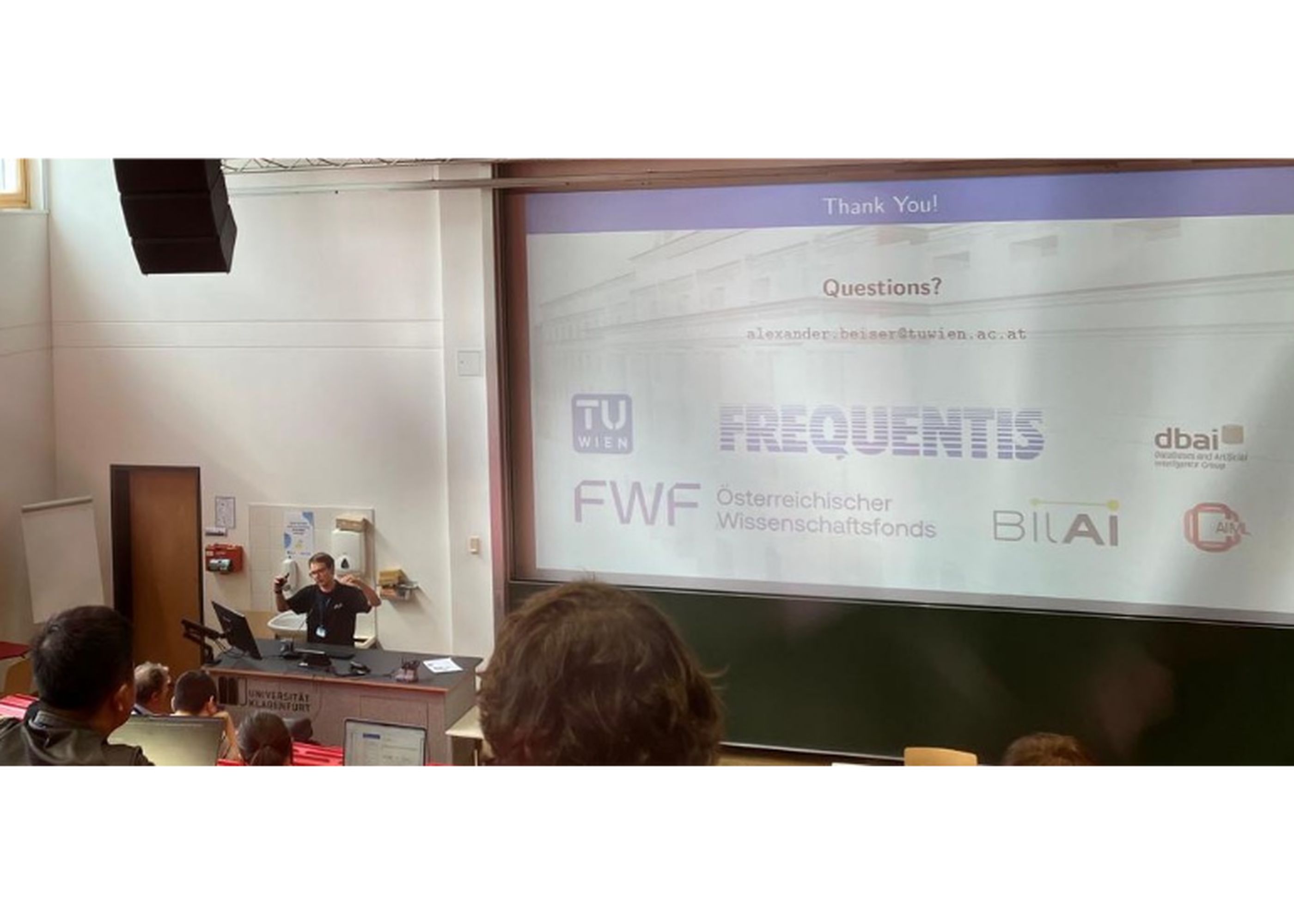
The next day, Alexander Beiser presented Joint Air Traffic Flow and Capacity Management via Answer Set Programming in the applications session, co-authored with Markus Hecher, Nysret Musliu, and Stefan Woltran. Air traffic management research typically optimizes either flight trajectories (delays and reroutes) or the airspace’s sector configuration, but not both. The paper introduces the first joint model based on navpoints as primitives together with the first ASP encoding for this problem. It was evaluated on instances from an open-source generator fitted to historical OpenSky Network flight data. There, the ASP approach outperforms a state-of-the-art mixed-integer programming model. On small instances, it also remains competitive with a heuristic modelled on CASA, the slot-allocation algorithm used in European operations. An ablation study shows that dynamic airspace configuration brings the largest gains. It also shows that search spaces should be “just big enough”, because unrestricted restructuring or rerouting leads to search-space thrashing.

Links
- LPNMR 2026: https://lpnmr2026.aics.aau.at/
- Joint ATFCM paper (arXiv): https://arxiv.org/abs/2606.22978